
 Introduction
The kidney is one of the most important organs in the mammalian excretory system, responsible for removing metabolic wastes, regulating the composition of body fluids, and maintaining a stable internal environment. Urine formation involves a series of highly coordinated processes occurring within the nephrons, including ultrafiltration, selective reabsorption, and tubular secretion. Understanding how urine is formed and the role of the kidneys in maintaining homeostasis is essential for mastering excretion and osmoregulation, making this topic a frequent feature in KCSE Biology examinations.
Explain the process of urine formation in the mammalian kidney and discuss the role of the kidney in maintaining homeostasis.
Model Answer
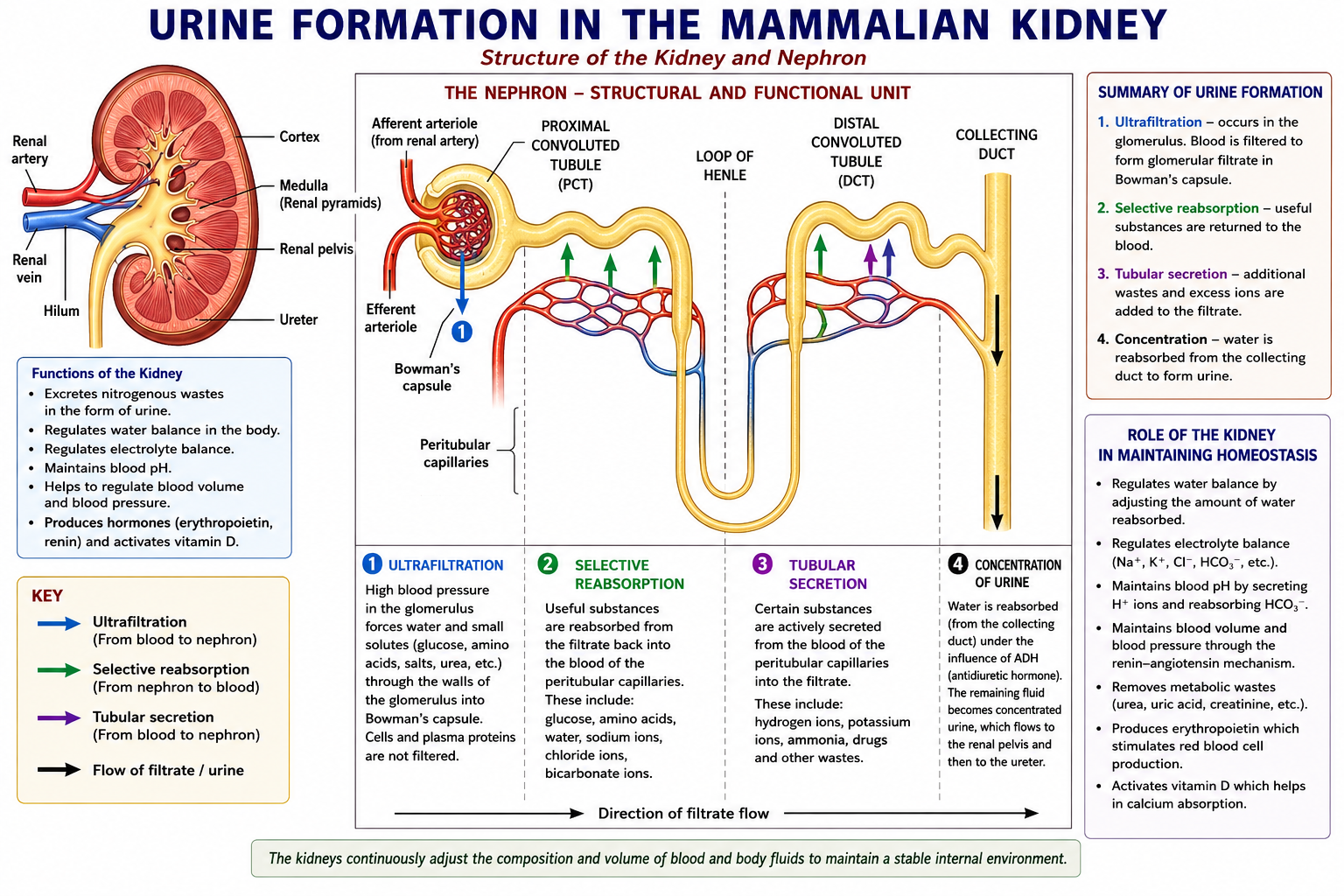
The kidneys are essential excretory organs responsible for removing metabolic waste products from the bloodstream while simultaneously regulating the composition of body fluids. Their functional units, known as nephrons, perform urine formation through a sequence of physiological processes, namely ultrafiltration, selective reabsorption, tubular secretion, and water conservation. Collectively, these processes ensure that useful substances are retained while waste materials are eliminated, thereby maintaining homeostasis.
Urine formation begins with ultrafiltration, which occurs in the renal corpuscle, comprising the glomerulus and Bowman’s capsule. Blood enters the glomerulus through the afferent arteriole under relatively high hydrostatic pressure because the afferent arteriole has a larger diameter than the efferent arteriole. This pressure forces water and small dissolved substances, including glucose, amino acids, mineral salts, urea, and vitamins, through the selectively permeable walls of the glomerular capillaries into Bowman’s capsule. However, large plasma proteins and blood cells are retained within the bloodstream because they are too large to pass through the filtration membrane.
The filtrate then enters the proximal convoluted tubule, where selective reabsorption takes place. During this stage, all glucose and amino acids are actively transported back into the surrounding capillaries. Most mineral salts are reabsorbed according to the body’s physiological requirements, while a substantial proportion of water returns to the bloodstream through osmosis. This process ensures that valuable nutrients are conserved and prevents excessive loss of water.
As the filtrate passes through the loop of Henle, further adjustments in water and salt concentration occur. The descending limb is permeable to water, allowing water molecules to diffuse into the surrounding medulla, whereas the ascending limb actively transports sodium and chloride ions into the surrounding tissues but is impermeable to water. This counter-current mechanism establishes an osmotic gradient that enables the production of concentrated urine when necessary.
The filtrate subsequently reaches the distal convoluted tubule, where tubular secretion occurs. During this process, excess hydrogen ions, potassium ions, ammonia, drugs, and other toxic substances are actively secreted from the blood into the filtrate. Tubular secretion contributes significantly to the regulation of blood pH and ionic balance while facilitating the removal of potentially harmful substances from the body.
The final stage of urine formation occurs within the collecting duct, where water reabsorption is regulated by antidiuretic hormone (ADH). When the body is dehydrated, increased secretion of ADH enhances the permeability of the collecting duct walls, allowing more water to be reabsorbed into the bloodstream. Consequently, a smaller volume of concentrated urine is produced. Conversely, when the body contains excess water, ADH secretion decreases, reducing water reabsorption and resulting in the production of a larger volume of dilute urine.
Beyond urine formation, the kidneys perform several important homeostatic functions. They regulate the body’s water balance by adjusting the volume of water reabsorbed according to physiological needs. They maintain electrolyte balance by controlling the concentrations of sodium, potassium, calcium, and chloride ions in body fluids. The kidneys also regulate blood pH by selectively excreting hydrogen ions while conserving bicarbonate ions, thereby preventing excessive acidity or alkalinity. In addition, they contribute to blood pressure regulation through the secretion of renin, stimulate red blood cell production by releasing erythropoietin, and activate vitamin D to promote calcium absorption and healthy bone development.
In conclusion, urine formation is a highly coordinated physiological process involving ultrafiltration, selective reabsorption, tubular secretion, and hormonally regulated water conservation. Through these mechanisms, the kidneys efficiently eliminate metabolic wastes while maintaining fluid balance, electrolyte concentration, acid-base equilibrium, and overall internal stability. Consequently, the kidneys play an indispensable role in preserving homeostasis and ensuring the normal functioning of the human body.
Conclusion
The formation of urine enables the body to eliminate nitrogenous wastes while conserving essential substances such as water, mineral salts, and glucose. Through the processes of ultrafiltration, selective reabsorption, and tubular secretion, the kidneys regulate the composition and volume of body fluids. Their role in osmoregulation, excretion, maintenance of blood pH, regulation of electrolyte balance, and control of blood volume makes them essential organs for maintaining homeostasis and ensuring the normal functioning of the body.