
 Introduction
The adaptations of the stomata are among the most frequently examined topics in KCSE Biology under plant physiology and gaseous exchange. Understanding how stomata regulate transpiration and facilitate gaseous exchange is essential for mastering plant nutrition, photosynthesis, and water conservation. In KCSE Biology Paper 2, candidates are often required to describe the structural adaptations of the stomata and explain how these adaptations enable the stomata to perform their functions efficiently.
This article presents a comprehensive KCSE Biology essay question, a detailed model answer, and examination-focused revision notes on the adaptations of the stomata. The resource is suitable for Form Four students, teachers, and candidates preparing for KCSE examinations who wish to strengthen their understanding of plant physiology and improve their essay-writing skills.
Essay Question (20 Marks)
Describe the Adaptations of the Stomata to their Functions.
Model Answer
The stomata are minute pores found mainly on the epidermis of leaves and young stems. They regulate gaseous exchange and transpiration by controlling the movement of carbon dioxide, oxygen, and water vapour between the plant and the surrounding environment. Their structure is highly specialized to enable them to perform these functions efficiently.
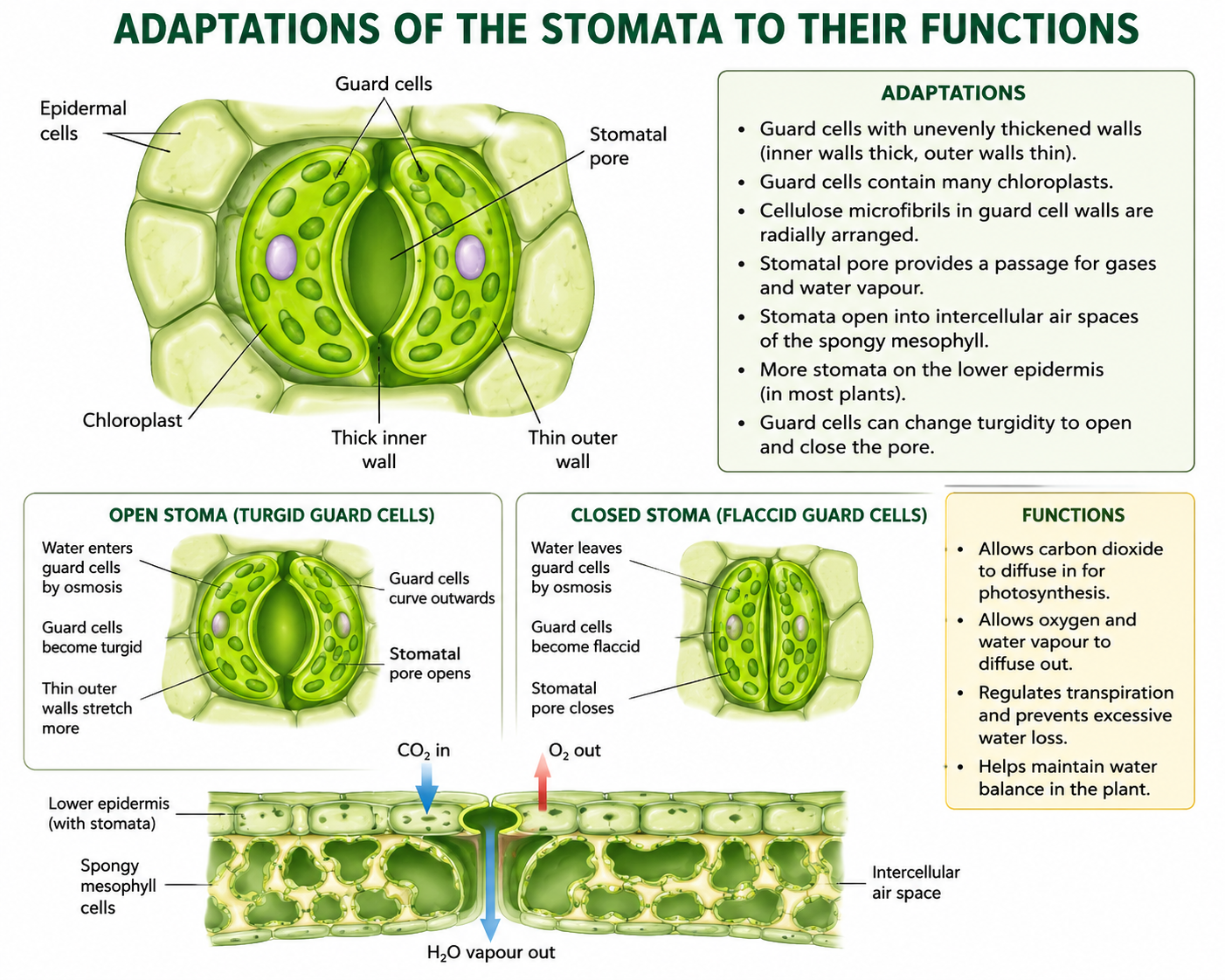
Each stoma is surrounded by a pair of guard cells that regulate the opening and closing of the stomatal pore. Changes in the turgidity of the guard cells cause the pore to open or close, thereby controlling the amount of water lost through transpiration while permitting the exchange of respiratory and photosynthetic gases.
The inner walls of the guard cells are thicker and less elastic than the outer walls. When the guard cells absorb water and become turgid, the thinner outer walls expand more than the thicker inner walls. This unequal expansion causes the guard cells to curve outwards, opening the stomatal pore. Loss of water causes the guard cells to become flaccid, resulting in closure of the pore and reducing excessive water loss.
The guard cells contain numerous chloroplasts, unlike the surrounding epidermal cells. These chloroplasts carry out photosynthesis, producing sugars that contribute to osmotic changes responsible for stomatal opening. The chloroplasts also enable the guard cells to respond effectively to changes in light intensity.
The radial arrangement of cellulose microfibrils within the guard cell walls allows the cells to bend rather than expand uniformly when they become turgid. This structural arrangement facilitates efficient opening and closing of the stomatal pore.
The stomatal pore provides a direct passage for carbon dioxide to diffuse into the leaf for photosynthesis while allowing oxygen produced during photosynthesis and water vapour produced during transpiration to diffuse out of the leaf.
The stomata communicate directly with the intercellular air spaces within the spongy mesophyll. This arrangement shortens the diffusion distance for gases and promotes rapid gaseous exchange between the atmosphere and the photosynthetic tissues.
In most terrestrial plants, stomata are more numerous on the lower epidermis than on the upper epidermis. This distribution reduces direct exposure to sunlight and wind, thereby minimizing excessive water loss through transpiration while maintaining efficient gaseous exchange.
The ability of the stomata to open during favourable environmental conditions and close during periods of water stress enables plants to maintain water balance while ensuring that adequate carbon dioxide enters the leaf for photosynthesis. This physiological regulation contributes significantly to the survival of plants under varying environmental conditions.
Conclusion
The stomata are highly specialized structures whose adaptations enable them to perform the dual functions of gaseous exchange and regulation of transpiration efficiently. Features such as specialized guard cells, unevenly thickened cell walls, chloroplasts, and direct communication with the intercellular air spaces ensure that the stomata respond effectively to changing environmental conditions. These adaptations allow plants to conserve water, maintain internal water balance, and support essential physiological processes such as photosynthesis and respiration, making the stomata indispensable to plant survival.
Looking for more KCSE Biology essay questions, model answers, revision notes, and examination resources? Contact Schools Net Kenya (SNK) for comprehensive KCSE revision materials, expertly prepared study notes, topical questions, and exam-focused learning resources designed to help students excel in their examinations. For inquiries, Whatsapp 0725 788 400.