
By: Karen A. Chagwaya
 Introduction
Gaseous exchange in fish is one of the most frequently tested topics in KCSE Biology, particularly under the study of respiration and adaptations of organisms. Students are expected to understand how bony fish obtain oxygen from water, eliminate carbon dioxide, and explain the structural adaptations that make the gills efficient respiratory organs. This article provides a comprehensive KCSE-standard essay question, a detailed model answer, and key examination points to help students prepare effectively.
KCSE Biology Essay Question
a) Describe the process of gaseous exchange in a bony fish.
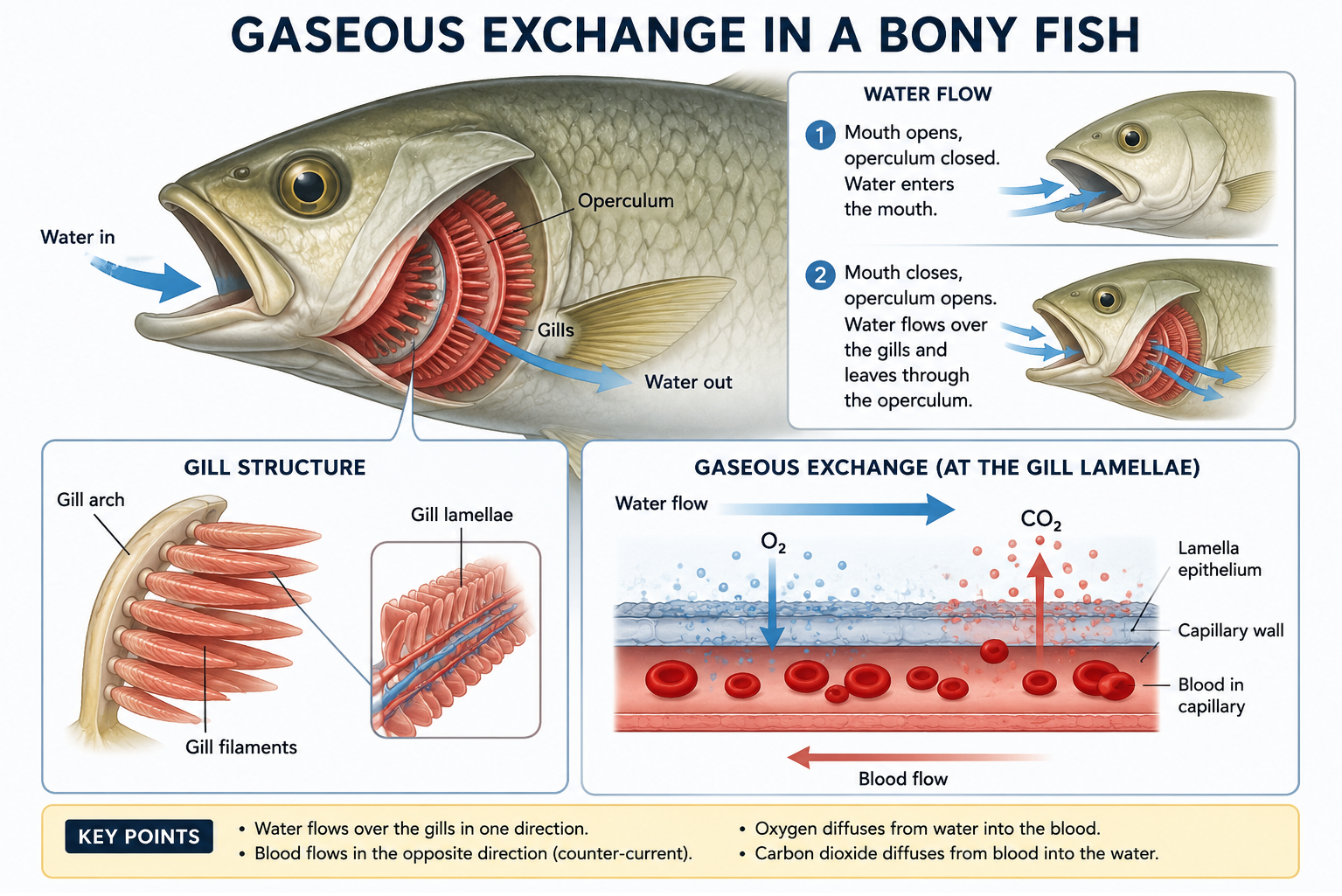
Gaseous exchange in a bony fish takes place in the gills, which are the specialized respiratory organs adapted for extracting dissolved oxygen from water and eliminating carbon dioxide. The process depends on a continuous flow of water over the gill surfaces and an efficient blood circulation that maintains a concentration gradient for the diffusion of respiratory gases.
Water enters the mouth as the fish opens its mouth and lowers the floor of the buccal cavity. At this stage, the operculum remains closed, creating a pressure difference that draws water into the buccal cavity.
The fish then closes its mouth while raising the floor of the buccal cavity. Simultaneously, the operculum opens, forcing water to flow over the gill arches, gill filaments, and gill lamellae before leaving the body through the opercular opening.
The gill filaments bear numerous gill lamellae, which provide a very large surface area for gaseous exchange. The lamellae possess thin epithelial walls and are richly supplied with blood capillaries carrying deoxygenated blood from the body.
As water flows over the gill lamellae, dissolved oxygen is present in a higher concentration in the water than in the blood flowing through the capillaries. Oxygen therefore diffuses across the thin walls of the lamellae into the blood, where it combines with haemoglobin in the red blood cells to form oxyhaemoglobin. The oxygenated blood is then transported to the rest of the body to support cellular respiration.
Carbon dioxide, which is present in a higher concentration in the blood than in the surrounding water, diffuses from the blood across the walls of the gill lamellae into the water. The carbon dioxide is carried away as water leaves the gill chamber through the operculum.
The efficiency of gaseous exchange is enhanced by the counter-current flow mechanism. Water passes over the gill lamellae in the opposite direction to the flow of blood within the capillaries. This arrangement maintains a concentration gradient along the entire length of the lamellae, ensuring that oxygen continues to diffuse into the blood while carbon dioxide diffuses continuously into the water. Consequently, a large proportion of the dissolved oxygen is extracted from the water before it leaves the gills.
The continuous pumping action of the mouth and operculum maintains an uninterrupted flow of water across the gills, ensuring a constant supply of oxygen and efficient removal of carbon dioxide even when the fish is stationary.
(b) Adaptations of the Gills for Gaseous Exchange
The gill filaments are numerous and bear many gill lamellae, providing a very large surface area for the diffusion of respiratory gases.
The walls of the gill lamellae are extremely thin, reducing the diffusion distance between the water and the blood.
The lamellae are richly supplied with blood capillaries that maintain a continuous flow of deoxygenated blood and sustain a steep concentration gradient for gaseous exchange.
The continuous movement of water over the gills ensures a constant supply of oxygenated water while removing carbon dioxide from the respiratory surface.
The counter-current flow mechanism maintains a diffusion gradient along the entire length of the lamellae, maximizing oxygen uptake.
The operculum protects the delicate gill structures and assists in pumping water continuously across the gills.
The gills remain moist because they are constantly bathed in water, allowing dissolved gases to diffuse readily across the respiratory surface.
Conclusion
A bony fish carries out gaseous exchange using highly specialized gills. Water is continuously pumped over the gill lamellae while blood flows in the opposite direction, maintaining a counter-current system that maximizes oxygen absorption and carbon dioxide removal. Structural adaptations such as numerous gill filaments, thin lamellae, rich blood supply, and the operculum enable the gills to function efficiently.
Looking for more KCSE Biology essay questions, model answers, revision notes, and examination resources? Contact Schools Net Kenya (SNK) for comprehensive KCSE revision materials, expertly prepared study notes, topical questions, and exam-focused learning resources designed to help students excel in their examinations. For inquiries, Whatsapp 0725 788 400.